
Layered Rice Cake

Layered rice cake is a beloved Local Hawaii treat with roots in Chinatown. Learn what makes it different from rice cake, plus a step-by-step recipe with coconut milk and tapioca starch.
This post may contain affiliate links. Our privacy policy.
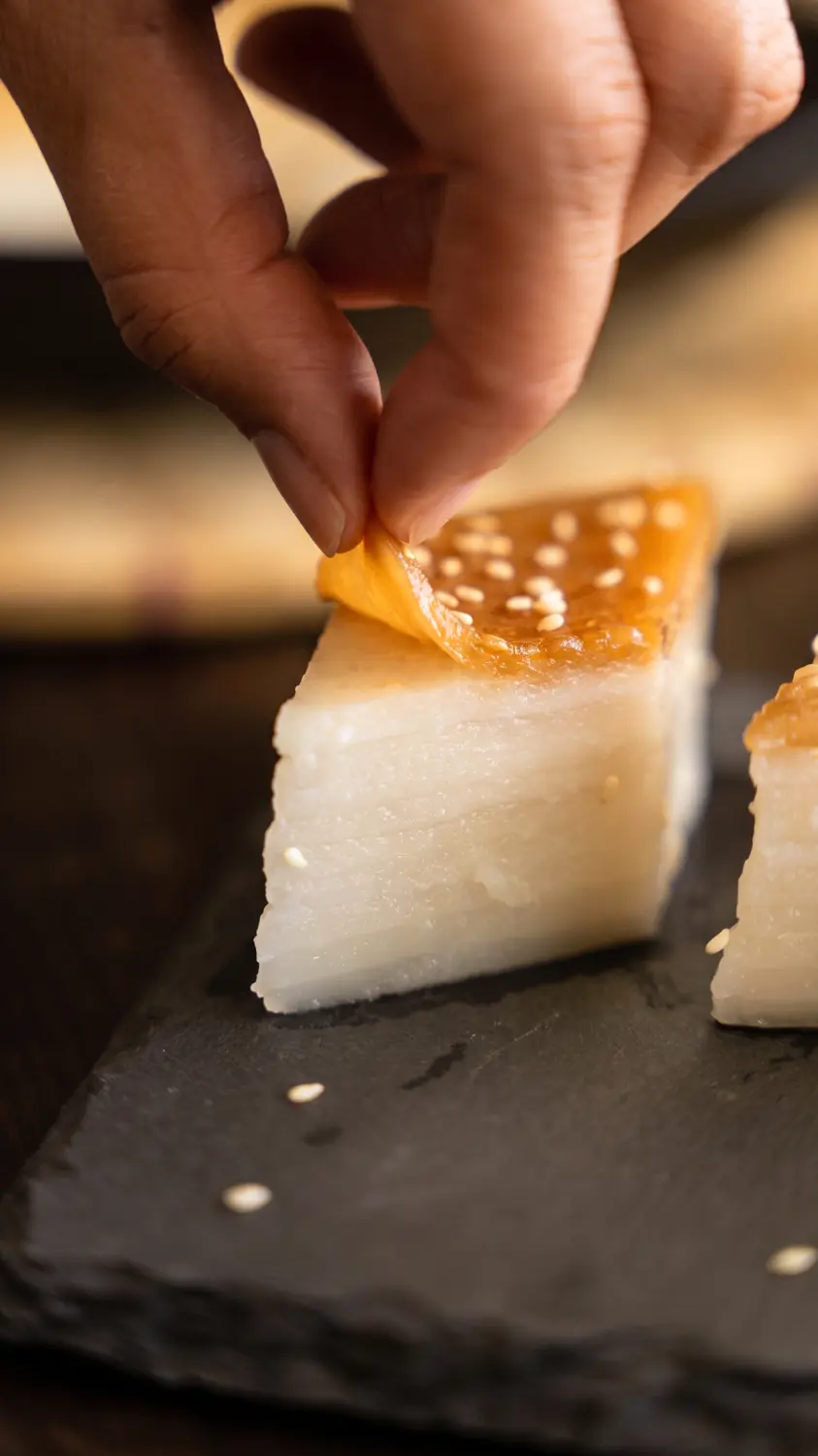
Growing up, I never actually tasted layered rice cake. But I heard about it. Always from the generation before me, the ones who knew the manapua man by name and who grew up making special trips to Chinatown like it was a holiday. My dad would light up just talking about it. The memory was vivid for him: his mom taking him as a kid, the treat waiting for him, translucent and layered, something you ate slowly and deliberately. You peeled it. One layer at a time. And you saved the brown top for last.
When I set out to make this at home, I ran into my first problem immediately: I could not find a definitive, official name for it anywhere. So I did what any Local girl would do. I called my dad. I called Aunty Gail. Neither of them knew the name either. My dad remembered the experience more than anything else: the peeling, the layers, that brown top, the Chinatown afternoon.
So I brought the question to my community. The response was overwhelming. People from all over, many of them from the very generation that grew up with this treat, came flooding in with their memories. And the answer came back clear: in Hawaii, this is called layered rice cake.
What is Layered Rice Cake?
Before we get into the kitchen, let’s clear something up: layered rice cake is not the same as rice cake. If you landed here searching for that soft, spongy, cake-like dessert, you’re thinking of a different recipe entirely. That one rises like a cake and has a fluffy, airy crumb. This one is built completely differently.
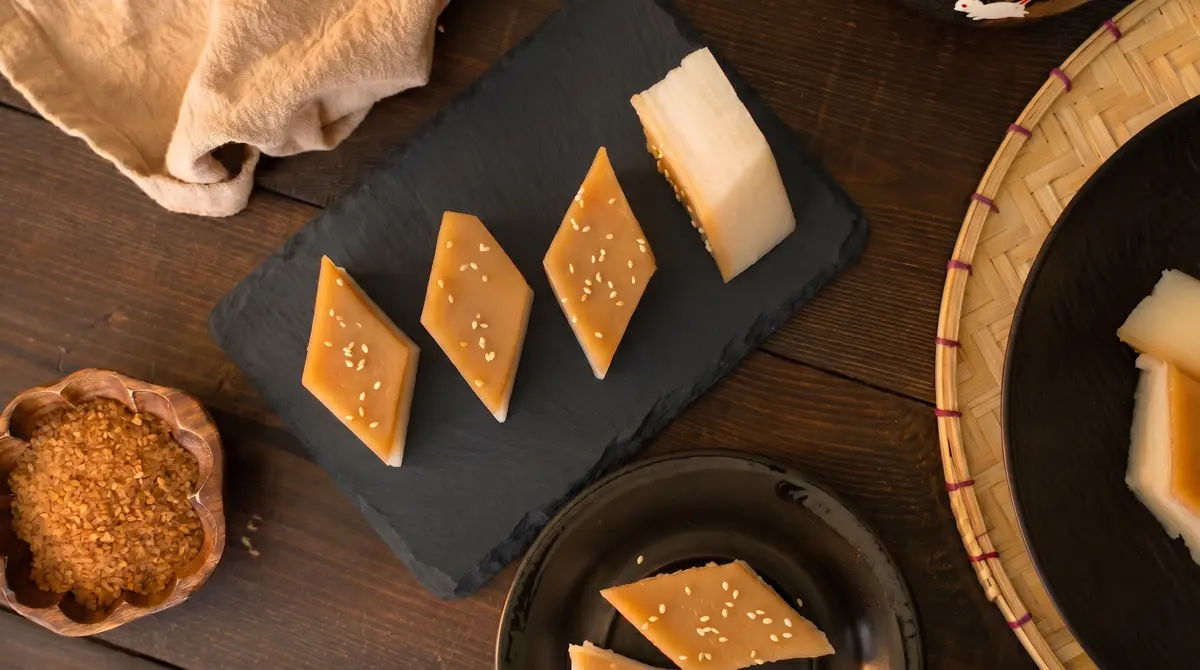
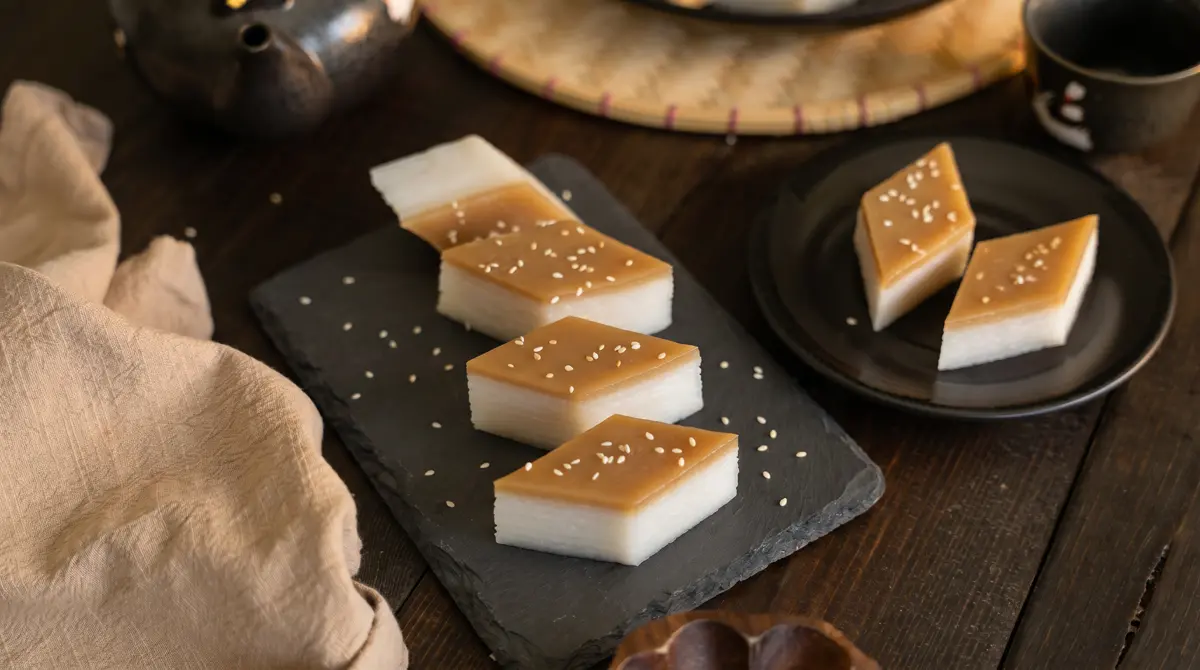
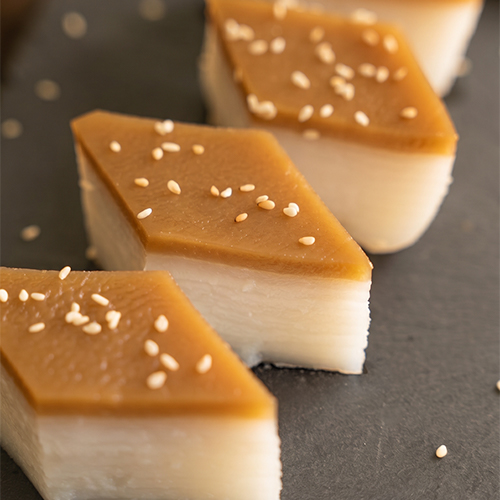
Layered rice cake is a steamed treat made one thin layer at a time. Each layer goes into the pan, steams until it sets and turns translucent, and then the next layer is poured on top. By the time it is done, you have a beautiful stack of smooth, slightly chewy layers all bonded together, topped with a darker brown layer made with raw cane sugar. You peel it apart to eat it. That is the whole experience.
What makes this especially remarkable is how many cultures across Southeast and East Asia have their own version. In Cambodia it is known as Nom Jakachan. In Malaysia, it goes by Kueh Lapis, with the Chinese characters 九层糕 literally translating to ‘9 layer cake.’ Vietnam has Banh Da Lon, their version of steamed layered cakes. Thailand calls it Khanom Chun. The name itself tells you everything: layers, stacked carefully, each one earned.
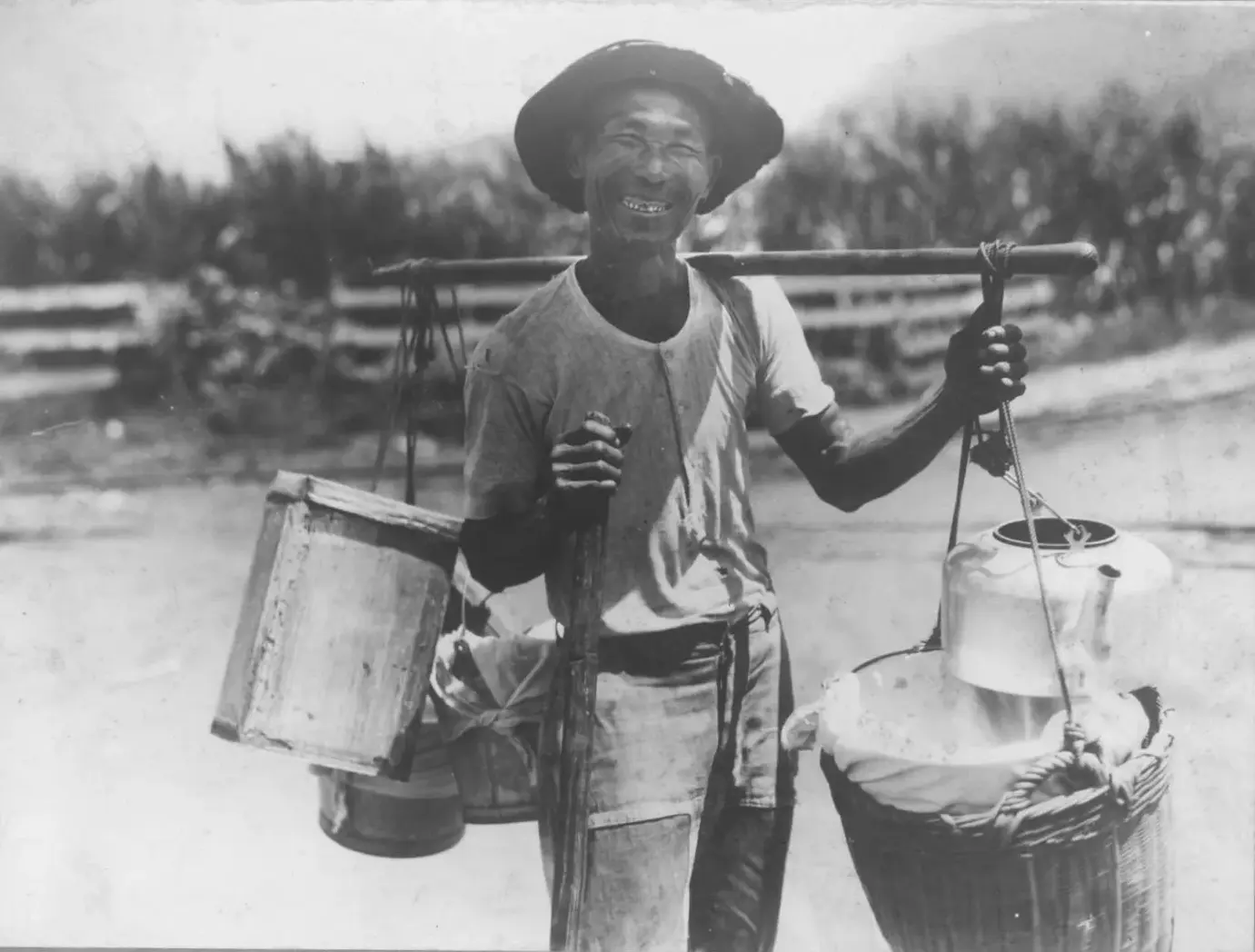
Here in Hawaii, this treat found its home in Chinatown and at the manapua man’s cart. For many local families, that cart was the connection to all kinds of treats that were not easily found anywhere else. People who grew up in Hawaii during certain eras will remember buying a piece and peeling it apart on the walk home, that brown top layer waiting like a reward at the end.
This is Local Hawaii food, shaped by the immigrant communities, particularly Chinese, that made Hawaii’s food culture what it is today.
Why You’ll Love This Layered Rice Cake
- It is a piece of living Local Hawaii food history, the kind of treat older generations still talk about with a particular look in their eyes
- The peeling experience is unlike anything else: layer by layer, saving the brown top for the very last bite
- The ingredient list is short, and the process is surprisingly satisfying once you find your rhythm
- The coconut flavor is delicate and not overpowering, just enough to make every layer taste like something special
- It is naturally gluten-free, made with rice flour and tapioca starch
- Impressive enough to bring to a potluck, personal enough to make on a slow Sunday afternoon

Ingredients for Layered Rice Cake
The ingredient list for this recipe is refreshingly short. Here is what makes each one matter:
- Rice Flour: The structural base of the batter. Rice flour gives the cake its peelable texture and slight firmness in each layer. Do not substitute all-purpose flour here. The texture and behavior will be completely wrong.
- Tapioca Flour / Tapioca Starch: This is what gives each layer its signature chewiness and that beautiful translucency when steamed. Tapioca flour and tapioca starch are the same thing and can be used interchangeably. Find it at any Asian grocery store or online.
- Full-Fat Coconut Milk: Do not reach for the light version here. Full-fat canned coconut milk is what carries the flavor of this dessert. Light coconut milk produces a thinner batter and noticeably less flavor in the finished layers.
- Whole Milk: Regular whole milk balances the richness of the coconut milk and helps the batter reach the right pourable consistency.
- White Sugar: This sweetens the main batter and goes into the milk mixture as it heats. By the time you pour the first layer, the sweetness is evenly dissolved throughout all eight white layers.
- Brown Sugar (Raw Cane Sugar): Reserved for the top layer only, which is what creates the signature darker brown finish that everyone saves for last. The raw cane sugar gives that final layer a slightly deeper, more complex sweetness that is noticeably different from the layers underneath it.
How to Make Layered Rice Cake, Step by Step
-
1
Mix the Dry Ingredients
Whisk together the rice flour and tapioca flour in a large bowl until evenly combined. Set this aside while you prepare the milk mixture.

-
2
Make the Milk Mixture
In a small pot, combine the water, coconut milk, whole milk, and white sugar. Heat over medium heat, stirring until the sugar dissolves completely. Remove from the heat and let it cool completely before adding it to the flour, about 15 minutes.
-
3
Combine the Batter and Prep the Top Layer
Once the milk mixture has cooled, pour it into the flour bowl and stir until smooth with no lumps. Then reserve one ladle of the batter in a small, separate bowl and stir in the brown sugar. This is your top layer. Keep it separate.
-
4
Set Up Your Steamer
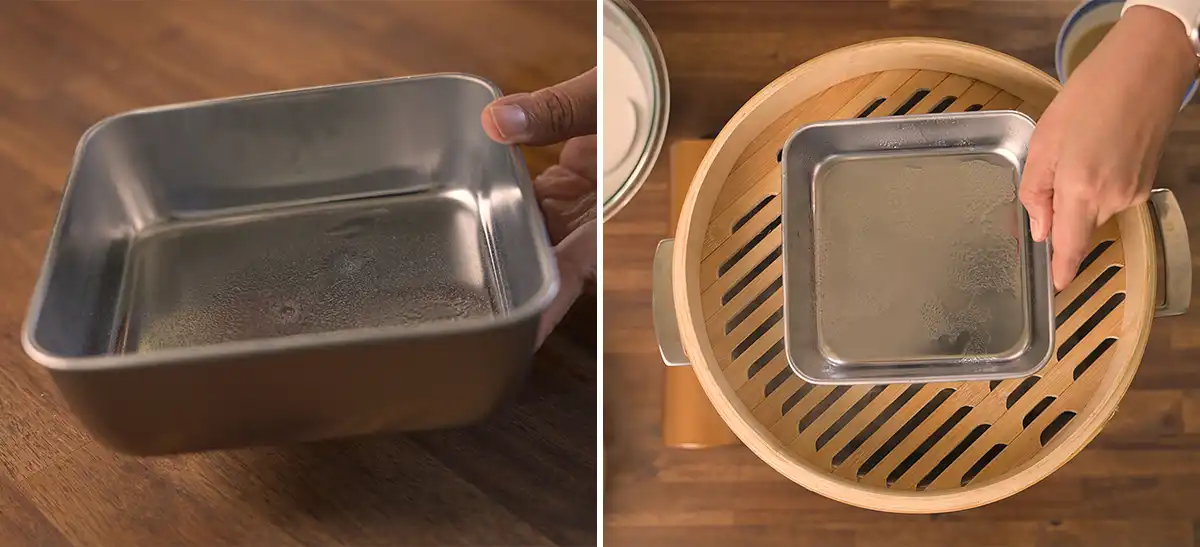
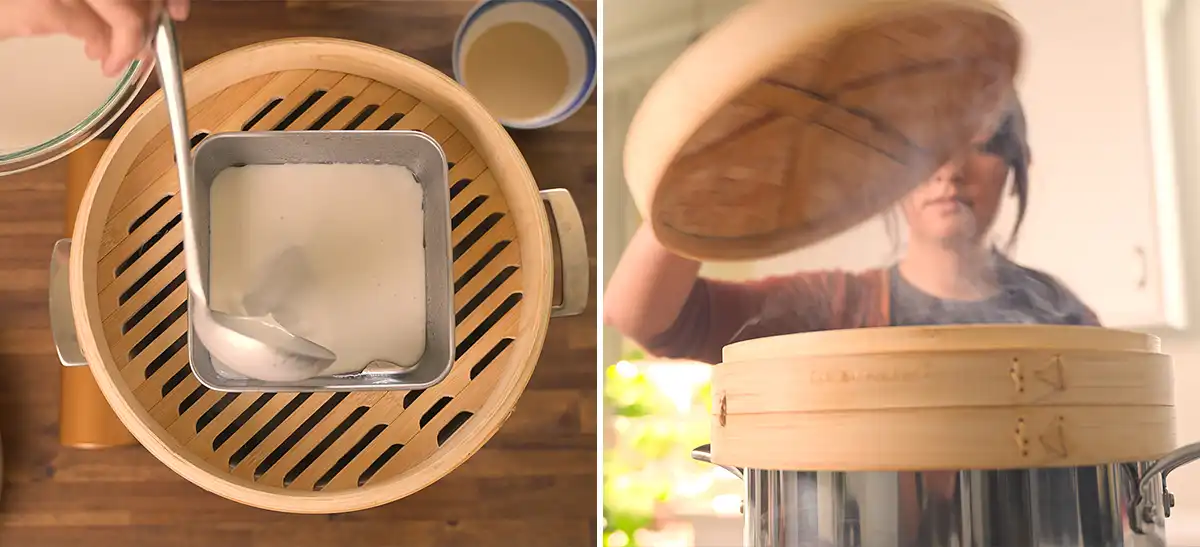
Heat your steamer with boiling water, then reduce to medium-low heat. Lightly mist a 6-inch square pan with oil on the sides and bottom. Place the pan into the steamer to warm up while you get ready to pour.
-
5
Steam Each Layer
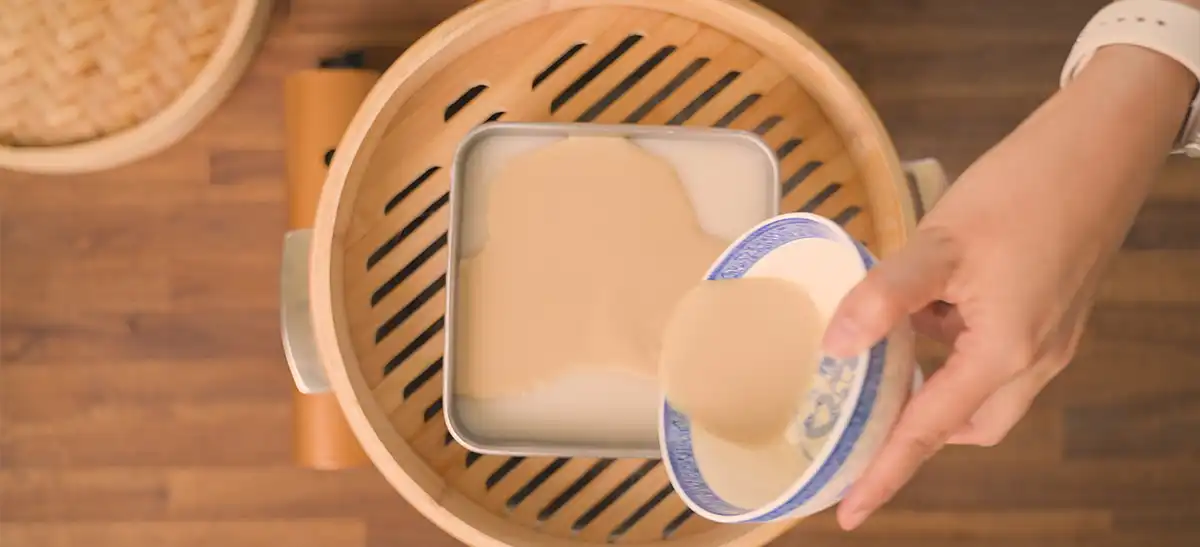
Before each pour, stir the batter well to re-dissolve any settled tapioca starch. Pour one ladle of batter into the pan. Cover and steam for 3 to 4 minutes. The layer is ready when it looks translucent and set. Repeat for 8 layers total. The last couple of layers may need an extra 1 to 2 minutes.
-
6
Add the Brown Top Layer
Stir the reserved brown sugar batter to recombine it, then pour it in as the final ninth layer. Cover and steam for about 6 minutes, until fully set. The slightly longer steam time accounts for the density the sugar adds.
-
7
Cool and Cut
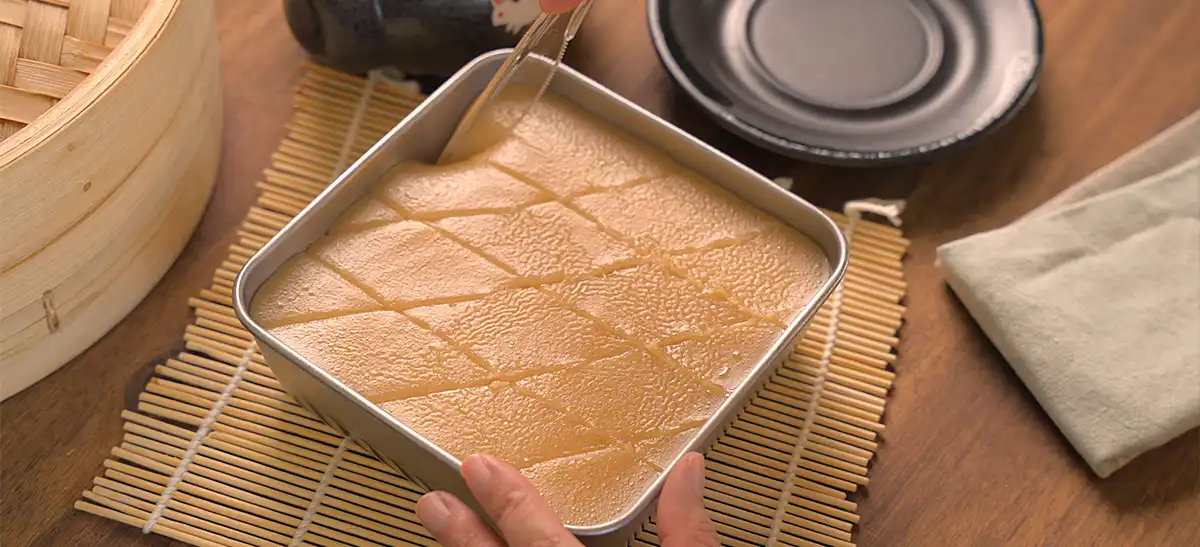
Remove the pan from the steamer and let it cool until just slightly warm before cutting. Cut into diamond shapes and serve.


💡 Pro tip: Reading the Steam
The visual cues during steaming matter more than the clock. Here is what to watch for:
• Layer still looks milky or white: Keep steaming. It is not set yet.
• Layer has wrinkles across the surface: The heat is too high. Turn it down.
• Layer has tiny bubbles all over: It cooked a little too long. Shorten the time slightly for the next layer.
• Layer looks translucent and smooth: It is ready. Move on to the next one.
What to Serve with Layered Rice Cake
Layered rice cake is a standalone treat, the kind you eat slowly and with intention. In the spirit of Local Hawaii’s Chinatown snacking culture, it pairs beautifully alongside other steamed and Chinese-influenced treats. If you want to put together a spread that captures the spirit of a Chinatown afternoon, pair it with manapua, crispy gau gee, or Chinese almond cookies.
Tips & FAQs
These are two completely different desserts that often get confused because the names sound similar. Rice cake (sometimes called steamed rice cake or fa gao-style cake) is soft, spongey, and cake-like in texture. Layered rice cake is firm, chewy, translucent in each layer, and meant to be peeled apart one layer at a time. Different texture, different technique, and a completely different eating experience.
The flavor is mild, coconutty, and gently sweet. The texture is smooth and pleasantly chewy. The brown top layer has a slightly deeper sweetness from the raw cane sugar, which is part of why everyone saves it for last.
It needs more time in the steamer. A fully cooked layer will look translucent, almost see-through. If it still looks opaque or white, give it another 1 to 2 minutes before adding your next layer. Rushing this step is the most common reason layers do not peel cleanly.
Yes. A bamboo steamer set over a wok or a large pot with a tight-fitting lid both work well. The key is consistent, steady steam throughout the whole process. If your lid is metal rather than bamboo, wrap it in a clean kitchen towel before putting it on. This catches condensation so it does not drip onto the cake.
Layered rice cake is sticky. A plastic knife glides through it cleanly without dragging or tearing the layers. A metal knife tends to stick and pull, which makes the cuts look rough. It is a small detail that makes a real difference in presentation. [Affiliate link: plastic knife set]
Storage & Make-Ahead Tips
It is best the day it is made or the day after. Store it covered at room temperature for up to 2 days. For longer storage, refrigerate in an airtight container for up to 4 days. Refrigeration will firm up the texture noticeably.
To restore the original softness, steam individual portions for 2 to 3 minutes before serving. Or microwave it for one minute. Do not freeze: freezing breaks down the tapioca starch and changes the texture permanently.
This recipe took me longer to track down than most, and honestly, the search felt like part of the story. Not everything in Local Hawaii food has a perfectly documented history or a universally agreed-upon name. Sometimes you call your dad. You call Aunty Gail. You post to your community and wait. And you piece it together from memory and love and a flood of responses from people who remember peeling these layers on the walk home from the manapua cart.
That is exactly how this one came to me. I hope making it brings you a little closer to those Chinatown afternoons and the generations that kept this treat alive. And if you peel that first layer and save the brown top for last, you are doing it exactly right.
With aloha,
Tani
Layered Rice Cake
Video
Ingredients
Batter
- 60 g rice flour
- 140 g tapioca flour (tapioca starch)
- 300 ml water
- 200 ml full-fat coconut milk canned
- 125 ml whole milk
- 5 oz white sugar 3/4 cup
Top Layer
- 0.5 oz brown sugar (raw cane sugar) about 1 tablespoon
Instructions
- Whisk together the rice flour and tapioca flour in a large bowl until evenly combined. Set aside.
- In a small pot, combine the water, coconut milk, whole milk, and white sugar. Heat over medium, stirring until the sugar dissolves completely. Remove from heat and let the mixture cool completely, about 15 minutes.
- Once cooled, pour the milk mixture into the flour bowl and stir until smooth. Reserve one ladle of the batter in a small separate bowl. Add the brown sugar to this reserved portion and stir to combine. Set aside. This is your brown top layer.
- Heat your steamer with boiling water, then reduce to medium-low. Lightly mist a 6-inch square pan with oil on the sides and bottom. Place the pan into the steamer to warm.
- Stir the main batter well to re-dissolve any settled tapioca starch before every pour. Ladle one scoop into the pan. Cover and steam for 3 to 4 minutes, until the layer looks translucent and fully set. If it still looks milky or white, keep steaming. Repeat for a total of 8 white layers. The last few layers may need an extra 1 to 2 minutes.
- Stir the reserved brown sugar batter to recombine. Pour it into the pan as the final ninth layer. Cover and steam for about 6 minutes, until fully set.
- Remove from the steamer and let cool slightly. Cut with a plastic knife into diamond shapes. Serve and enjoy.
Notes
- If a layer has wrinkles, the heat is too high. Lower it before the next layer.
- If a layer has tiny bubbles, it cooked slightly too long.
- Wrap a kitchen towel around the lid if not using bamboo to prevent condensation from dripping onto the layers.
- Store covered at room temperature for up to 2 days, or in an airtight container in the refrigerator for up to 4 days.
- Re-steam refrigerated pieces for 2 to 3 minutes to restore the original texture. Or microwave for a minute. Do not freeze.


Mahalo Tani..
You brought one of my most treasured memories back. The Manapua Man & Layered rice cake.
I’ve been on the mainland for many years, but I go home every year to visit family & eat all the kau-kau I miss, or am too lazy to make.
I’m anxous to make the layered rice cake for my ohana. How many ounces does your ladle hold?
Again, mahalo for sharing this recipe and for the memory of a time gone by.
Aloha! I’m so glad these have brought back good memories!
I weighted the amount for the ladle to be around 70-73g.
Hope that helps!
This is a tasty recipe but it tastes more like mochi than it does like the 9 layer cake I remember from growing up in Hawaii. Steaming times were quite a bit longer but I did get those satisfying layers.
Mahalo for giving it a try. I would love to know what kind of flavors it had or how it tasted back in the days. I can always use feedback to improve the recipe 🙂
I made the rice cake today. Sadly, the layers did not form. But it’s still ono ! Do you have any thoughts on why the layers didn’t form? Did the layers need more steaming time? I would appreciate any help. THANKS for the recipe!
Thank you so much for sharing this Ricey recipe. This is my ultimate favorite-I love peeling the layers off and saving the top brown layer for last. I just finished making it, letting it cool and will share it with my son and family.
I hope tastes as good as your recipe shows. Will post again with an update!
Ahhh I’m excited to hear how it turned out!
Layer Cake #1
Yessah!
Char Hung Sut made the layered rice cake since I was a child. Thanks for sharing.
Mahalo! Yes you are right 🙂
I love this layered Rice Cake for years . But we’re i live its hard to fine and bye it .. I was lucky fine this recipes.
I’m so glad you stumbled upon it! Let me know how it turns out for you when you get a chance.
Can this be a 2 layer rice cake? 1 very thick layer and the brown sugar layer on top? If so what would the steaming times be? Thank you,
I haven’t tried that but I would suggest maybe start with 15-20 minutes for the first layer. Watch it closely. Make sure there are no jiggles, the color changes to the translucent white or grey. Same thing for the brown layer. Just watch for the clues of it being cooked.
Iʻve never seen a recipe…one of my desserts! Thank you!
That is exactly what pushed me to make this one! It took me a while to track down because so little of it has ever been written down. It lived in memory more than anywhere else. I’m so glad it found you. Enjoy every layer.
God Bless you for investigating this RECIPE!!!!! I make rice cakes here in Las Vegas (OG EWA PLANTATION KID 1964) watching this brought tears in my eyes cause I haven’t ate that since growing up as a kid in “Old Ewa Sugar Plantation” now I can have my kids & grandkids experience this AWESOME desert…My Donor heart and I thank you very much….Jessie V.
Jessie, I have read this comment so many times. It gave me chicken skin the first time and it still does.
Ewa Plantation, 1964, and now you’re here wanting your kids and grandkids to taste what you grew up eating. That is the whole reason I make these videos. Not for views. For exactly this.
And you mentioned your donor heart and I just want to say, the fact that you’re here, that you found this video, that this brought you back to something you loved as a kid, that means everything to me. I hope you make it, I hope it tastes exactly like you remember, and I hope your kids and grandkids understand just how special what they’re eating really is.
Mahalo nui loa, Jessie. From the bottom of my heart.
Brought over to Hawaii by early Cantonese Chinese plantation immigrants, “Gau cung gou” (also known as coconut milk thousand-layer cake or Nyonya cake) is a traditional Southeast Asian and Chinese steamed cake, renowned for its layered, chewy, soft, and chewy texture. It is usually made from cassava flour or rice flour and comes in various flavors and versions. If you’re from Hawaii, and you grew up chasing the manapua man truck like I did for this delicious snack treat, you will appreciate these memories.
1. Common Types and Names
Nyonya Kuih Lapis: A classic dessert from Baba Nyangya in Southeast Asia (Malaysia, Singapore, Indonesia, etc.), commonly featuring green and white colors or vibrant rainbow colors. The green color often comes from natural Pandan juice, combined with coconut milk, offering a rich aroma.
Cantonese Chinese/Hakka Nine-Layer Cake: A traditional Chinese rice dish, also known as “Nine-Layer Rice Cake.” It is usually white and brown, often seasoned with black or brown sugar, and has a subtle caramel aroma.
The traditional nine-layer cake preparation involves mixing the flour paste (usually cassava flour, glutinous rice flour, or freshly made rice flour) with coconut milk, sugar, and other ingredients, and then separating them into different colors. Then preheat the container and pour it layer by layer into the pulp to steam until cooked. After one layer solidifies, another layer is poured over, repeatedly stacking multiple layers (not necessarily exactly nine layers, symbolizing continuous upward advancement or long-term growth). Steam it and let it cool, then refrigerate and slice it into pieces for consumption. It has a cool and chewy texture.
Great recipe, great recollection, Mahalo nui…
Wow! Thank you for taking the time to write all of this out.
This is exactly the kind of knowledge I was hoping this video would bring out of the community.
The Nyonya Kuih Lapis connection, the Cantonese and Hakka lineage, the symbolism of the layers representing continuous upward growth, the cassava flour variations, all of it adds so much depth to what I was able to share.
And yes, chasing the manapua man is a memory that binds so many of us together regardless of what we called this cake when we were kids.
Thank you for adding to the record. Mahalo nui. 🤙
We called this layer rice cake “gau soong gao” 9 layer cake. Too bad it is not made anymore in Honolulu.
This just made my whole day.
Thank you so much for sharing that name.
“Gau soong gao” is beautiful and I love that you grew up knowing it by that name.
And you’re so right, it breaks my heart that it’s become so hard to find in Honolulu.
That’s exactly why I wanted to get this recipe documented and out there.
So that even if the shops and carts are gone, it doesn’t disappear entirely. Mahalo nui for this.
Thank you for posting this recipe! Any other tips if I don’t have a steamer? Can I double the recipe in a 9×13 pan?
Great questions!
For no steamer, a large pot with a lid works perfectly. Place a small rack or trivet inside, add water below the rack, and rest your pan on top. Keep the heat at medium-low and you’re good to go. If you have an Instant Pot, the steam setting works beautifully too.
For the 9×13 pan, I’d actually recommend tripling the recipe rather than doubling it. A 9×13 is about three times the size of a 6-inch square pan, so doubling would give you noticeably thinner layers. Tripling keeps the layer thickness closer to what the recipe intends. Just know the last few layers and the brown top will need a little extra steaming time in the larger pan. Let me know how it turns out! 🤙
What are the standard US measurements for the ingredients? I don’t know how many cups 140 g of tapioca flour is.
I have been searching for a recipe. The layered rice cake disappeared during Covid. Thank you soooo much for sharing your recipe and for your tenacity to track this down. I’m looking forward to trying this out!
Of course! I realized that there was no one who shared this recipe. It became a little special to me to make sure this recipe was highlighted. Let me know how it turned out!
What a memory from my childhood !!! Can’t wait to try this. Thanks for sharing so many memories of growing up in Hawaii.
Ahh you are so welcome! Please let me know how it turns out 🙂