
Hawaiian Food vs. Local Hawaii Food

Let’s Start With Pineapple
Can we talk story for a second about Hawaiian food vs local food?
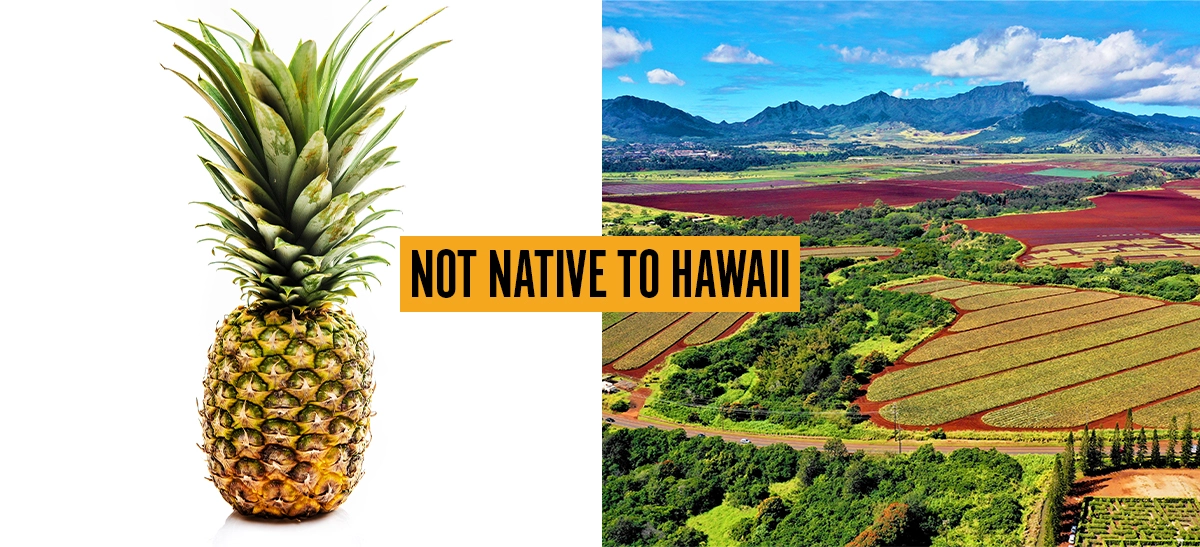
If you’ve ever been told that pineapple is Hawaiian (whether it was on a pizza, in a fruit bowl at a hotel luau, or slapped on a “Hawaiian” burger) I want you to know: pineapple is not native to Hawaiʻi.
Not even close.
Pineapple is native to South America. It arrived in Hawaiʻi in the late 1700s, and it wasn’t until the early 1900s that James Dole started commercializing it on a massive scale. The marketing was so effective that the whole world started associating pineapple with Hawaiʻi. And honestly? That association stuck so hard that it overshadowed what real Hawaiian food actually is.
That’s exactly why I wanted to write this post.
The food of Hawaiʻi is layered, rich, and deeply meaningful, and it deserves to be understood correctly. So let’s break it down together: what is Hawaiian food, and what is Local Hawaii food, the kamaʻāina cuisine that grew up right alongside it?
Why This Distinction Matters
This isn’t about being picky or gatekeeping food. It’s about respect and accuracy.
When we blur these lines, we risk erasing the cultural stories behind the food: who made it, why they made it, and what it means to the people of Hawaiʻi. Hawaiian food carries the history of the Native Hawaiian people. Local food carries the stories of every family that came to these islands and made it their home. Both deserve to be honored correctly.
So let’s talk story. Understanding Hawaiian food vs local food is how we honor both.
Hawaiian Food: Rooted in the ʻĀina and Kai
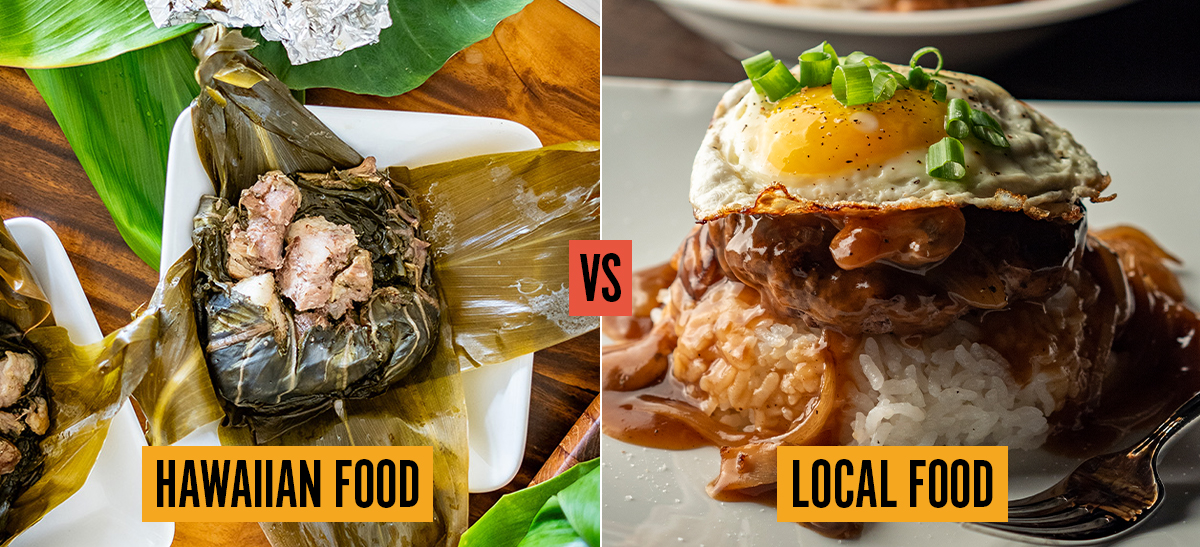
True, traditional Hawaiian food comes from the Native Hawaiian people. It is food that was developed over centuries, shaped by a deep connection to the ʻāina (land) and the kai (sea).
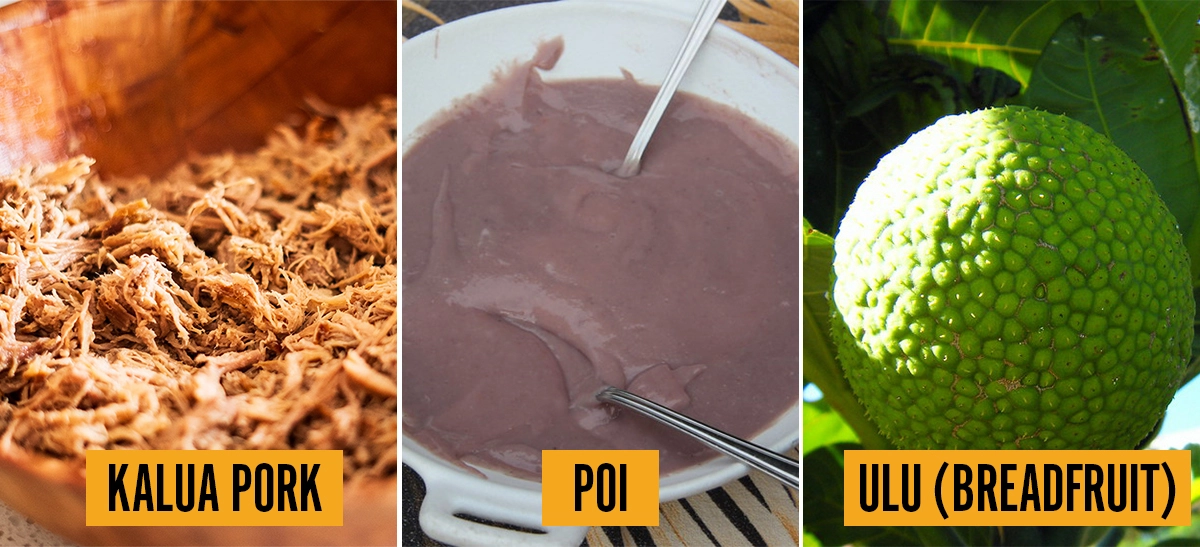
Long before contact with the Western world, Native Hawaiians had a sophisticated food system. They cultivated kalo (taro) in flooded loʻi (taro paddies), fished the reefs and open ocean, raised pigs and chickens, and tended to ʻulu (breadfruit) trees. Nothing was wasted. Everything had purpose.
Some of the most iconic traditional Hawaiian dishes include:
- Poi: Pounded kalo (taro root), fermented to varying consistencies. It is a staple food, a cultural cornerstone, and deeply sacred to Native Hawaiians. Kalo is considered an ancestor.
- Kalua Pig: A whole pig cooked in an imu, an underground oven lined with hot lava rocks, banana leaves, and ti leaves. It takes hours. The result is fall-apart, smoky, incredibly tender pork.
- Laulau: Pork (and sometimes fish) wrapped in lūʻau leaves (taro leaves) and ti leaves, then steamed until meltingly soft.
- ʻOpihi: Limpets harvested from the rocks along the ocean shore. Eaten raw or cooked. A true delicacy.
- Haupia: A firm coconut milk pudding, traditionally set in ti leaves. Still found at every lūʻau and family gathering.
- Poke (traditional): This is not the poke bowl you see at mainland fast casual spots. Original poke is simply cubed raw fish, typically aku (skipjack tuna), seasoned with limu (seaweed), inamona (roasted kukui nut relish), and Hawaiian salt. Simple. Clean. Perfect.
- ʻUlu: Breadfruit. Roasted, steamed, pounded. Incredibly versatile and a major food source.
- Lomi Lomi Salmon: Salted salmon gently massaged with tomatoes and green onions. Refreshing, simple, and a staple at every lūʻau table.
- Squid Lūʻau: Squid cooked in coconut milk with lūʻau leaves. Rich, savory, deeply comforting.
What makes Hawaiian food distinct is its connection to place. These aren’t just ingredients. They are part of a worldview where food and land and people are inseparable. To eat kalo is to be connected to something much older and much greater than a meal.
A Brief History: The Plantation Era and How Local Food Was Born
To understand Local Hawaii food, you have to understand where it came from. And that story starts in the sugar fields.
Beginning in the mid-1800s, sugar plantations became the economic backbone of Hawaiʻi. The demand for cheap labor was enormous. So plantation owners brought in workers from all over the world, from China, Japan, Portugal, Puerto Rico, Korea, and the Philippines, in waves over several decades.
These workers came with almost nothing. Many left behind families, hoping to send money home. They were paid very little, housed in plantation camps divided by ethnicity, and given grueling work in the cane fields under the hot sun. It was hard, hard living.
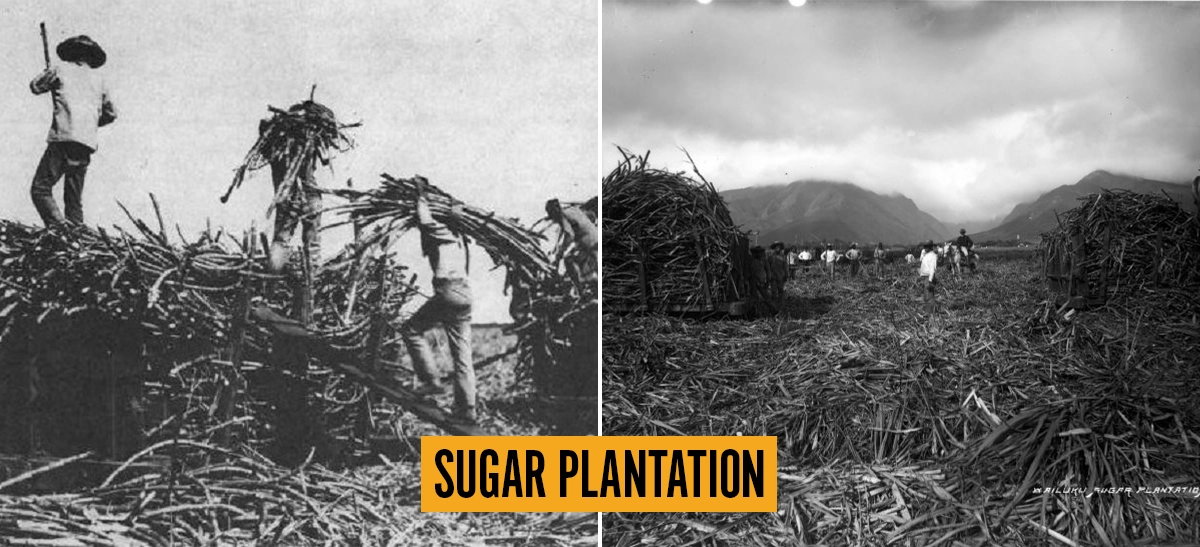
But in those camps, in the spaces between work and sleep, something remarkable happened. People from wildly different cultures began sharing. Sharing food. Sharing techniques. Sharing flavors.
A Japanese worker might share onigiri with a Filipino worker who brought adobo. Korean workers brought kimchi and doenjang. Chinese workers brought char siu and noodles. Puerto Rican workers brought sofrito and rice dishes.
And slowly, beautifully, all of it began to blend.
What grew out of those plantation camps became something that belongs entirely to Hawaiʻi: a cuisine that is not one culture’s food, but every culture’s food, transformed by the islands into something completely its own.
That is Local Hawaii food.
Local Hawaii Food: Born in the Islands, Raised by Everyone
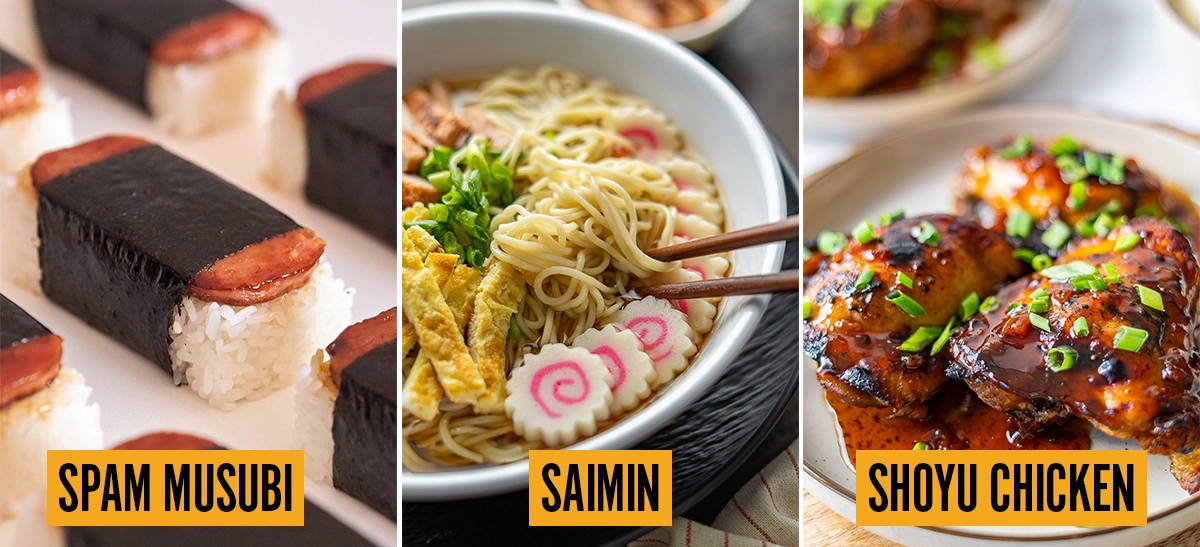
Local Hawaii food (you’ll also hear it called Hawaii-style food) is the everyday cuisine of the islands. It’s what kamaʻāina, longtime residents and those raised in Hawaiʻi, just call “food.” It’s the plate lunch spots, the potlucks, the graduation parties, the school fundraisers, and the family kitchens.
It is not Hawaiian food. It is not Japanese food or Filipino food or Portuguese food. It is its own thing, and it is absolutely worth celebrating.
Some of the most beloved Local Hawaii dishes include:
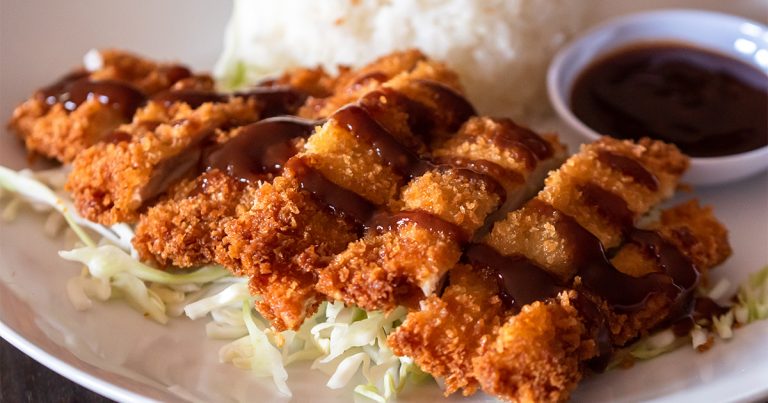
- Plate Lunch: The cornerstone of Local food culture. Two scoops of white rice, a scoop of macaroni salad, and your choice of protein (teriyaki beef, katsu chicken, kalua pork, etc.). It was born in the plantation fields when workers brought mixed lunches and shared them.
- Spam Musubi: Grilled Spam on a block of rice, wrapped in nori. Spam became popular in Hawaiʻi during World War II when fresh meat was rationed, and locals made it their own in a very real way.
- Saimin: Hawaiʻi’s own noodle soup. The broth draws from Japanese dashi, the noodles are Chinese-influenced, and the toppings (Spam, fishcake, green onion, char siu) come from everywhere. It is deeply Local.
- Loco Moco: White rice topped with a hamburger patty, a fried egg, and brown gravy. Born in Hilo in the late 1940s. Pure comfort food.
- Manapua: Hawaiʻi’s take on char siu bao (Chinese steamed buns). The name comes from the Hawaiian phrase “mea ʻono puaʻa,” which means delicious pork thing.
- Malasadas: Portuguese fried doughnuts coated in sugar. No hole, just pillowy fried dough. Brought by Portuguese workers from the Azores and Madeira.
- Portuguese Bean Soup: A hearty, smoky soup with kidney beans, linguiça, ham hock, and vegetables. As Local as it gets.
- Shoyu Chicken: Chicken braised in soy sauce (shoyu), sugar, ginger, and garlic. Japanese-influenced, completely claimed by Local Hawaii cooking.
- Mochiko Chicken: Crispy, lightly sweet fried chicken made with mochiko (rice flour). A Local favorite at every potluck and plate lunch spot.
- Chicken/Pork Adobo: Filipino adobo made its way into Local Hawaii kitchens and never left. Tangy, savory, and perfect over rice.
What makes Local Hawaii food so special is that it is living proof of what happens when people from different backgrounds are forced, or choose, to live alongside each other. The food that came out of those plantation camps is not a lesser version of any one cuisine. It is its own cuisine, shaped by Hawaiʻi itself.
Let’s Clear Up Some Common Misconceptions
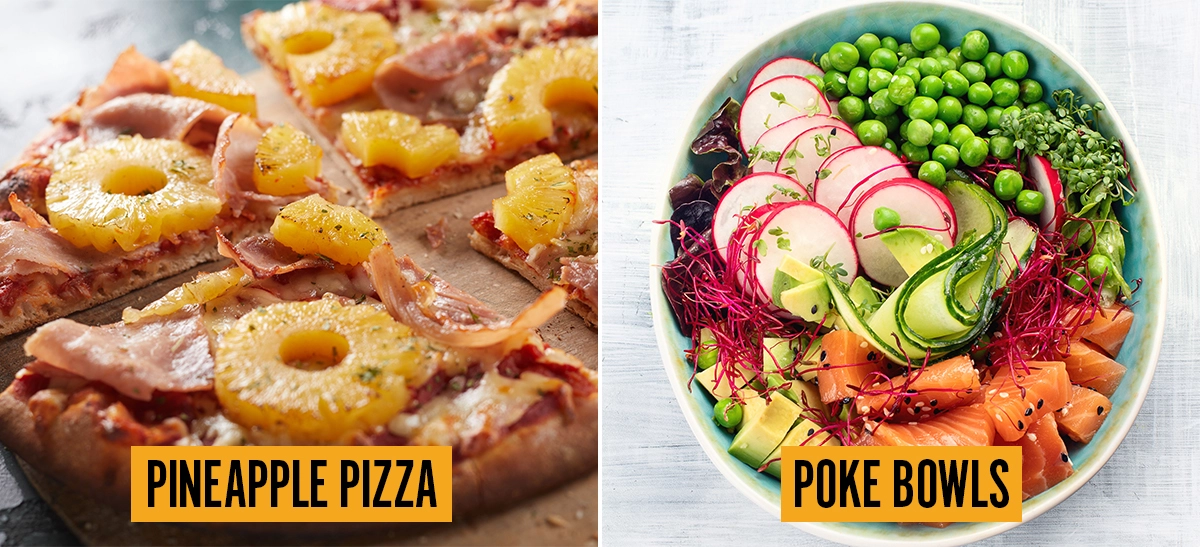
Since we’re already talking story, let’s just get through a few of the big ones:
Hawaiian Pizza is not Hawaiian.
It was invented in 1962 by Sam Panopoulos, a Greek immigrant, at a restaurant in Ontario, Canada. The pineapple-and-ham combo has nothing to do with Hawaiʻi. Nothing.
“Hawaiian BBQ” restaurant chains are not Hawaiian food.
They serve Local-style food: plate lunches, macaroni salad, and teriyaki, which is good food! But calling it “Hawaiian” flattens a whole culture down to a brand name.
Pineapple is not a Hawaiian ingredient in traditional cooking.
We’ve covered this. Pineapple is South American. It became commercially associated with Hawaiʻi through Dole’s marketing machine. It is not a part of traditional Hawaiian cuisine.
Poke bowls at mainland restaurants are not traditional poke.
The poke bowl trend that exploded on the mainland bears little resemblance to traditional Hawaiian poke. Original poke is simple: cubed raw fish, limu, inamona, and Hawaiian salt. The build-your-own-bowl with edamame, mango, and sriracha aioli is a completely different thing. Not wrong, just different.
It All Matters. And It’s All Worth Celebrating
Here’s the thing I want you to walk away with:
Hawaiian food and Local Hawaii food are two distinct and beautiful things, and both of them deserve to be understood, respected, and celebrated for exactly what they are.
Hawaiian food is the food of the Native Hawaiian people. It is ancient, sacred, and deeply tied to the land and sea of these islands. To call a pineapple dish “Hawaiian food” is to erase that history.
Local Hawaii food is the food that grew from Hawaiʻi’s multicultural heart: out of hardship, out of community, out of people from all over the world making a home together. It is the everyday food of the islands, and it is uniquely and entirely Hawaiʻi’s own.
Every time you sit down to eat poi, you’re connecting to something ancient. Every time you open a plate lunch, you’re tasting a century of community.
That’s the beauty of Hawaiʻi’s food culture. All of it belongs. All of it has a story. And now you know how to tell them apart.
Me ke aloha,
Tani
Liked this post? Share it with someone who thinks pineapple is Hawaiian. 😄

I am so happy you explained the differences of the authentic foods which I enjoy eating. Wish I could get some of the great foods here on Idaho. I try. I’m not Hawaiian but feel a deep connection to the culture ever since I was just a tiny little girl in the early 1950’s before statehood. My first trip to the Islands was to Hilo and Honolulu in 1068 and fell on love witb every thing about it. Been back many times and each time I am a bit saddened as to what the true Hawaiians keep losing.
Please keep educating people about the true Hawaiian ways. Thank you for your recipes. Jo
Mahalo for first of all reading this! It means a lot. It has been on my mind lately and felt inspired to write about it.
What a story, falling in love with the islands on that first trip and carrying that connection for decades. You’re right that a lot has been lost, and that’s exactly why I keep writing about the real foods and traditions, so they don’t fade away. I’ll keep sharing as long as people like you keep caring. Sending aloha to Idaho!